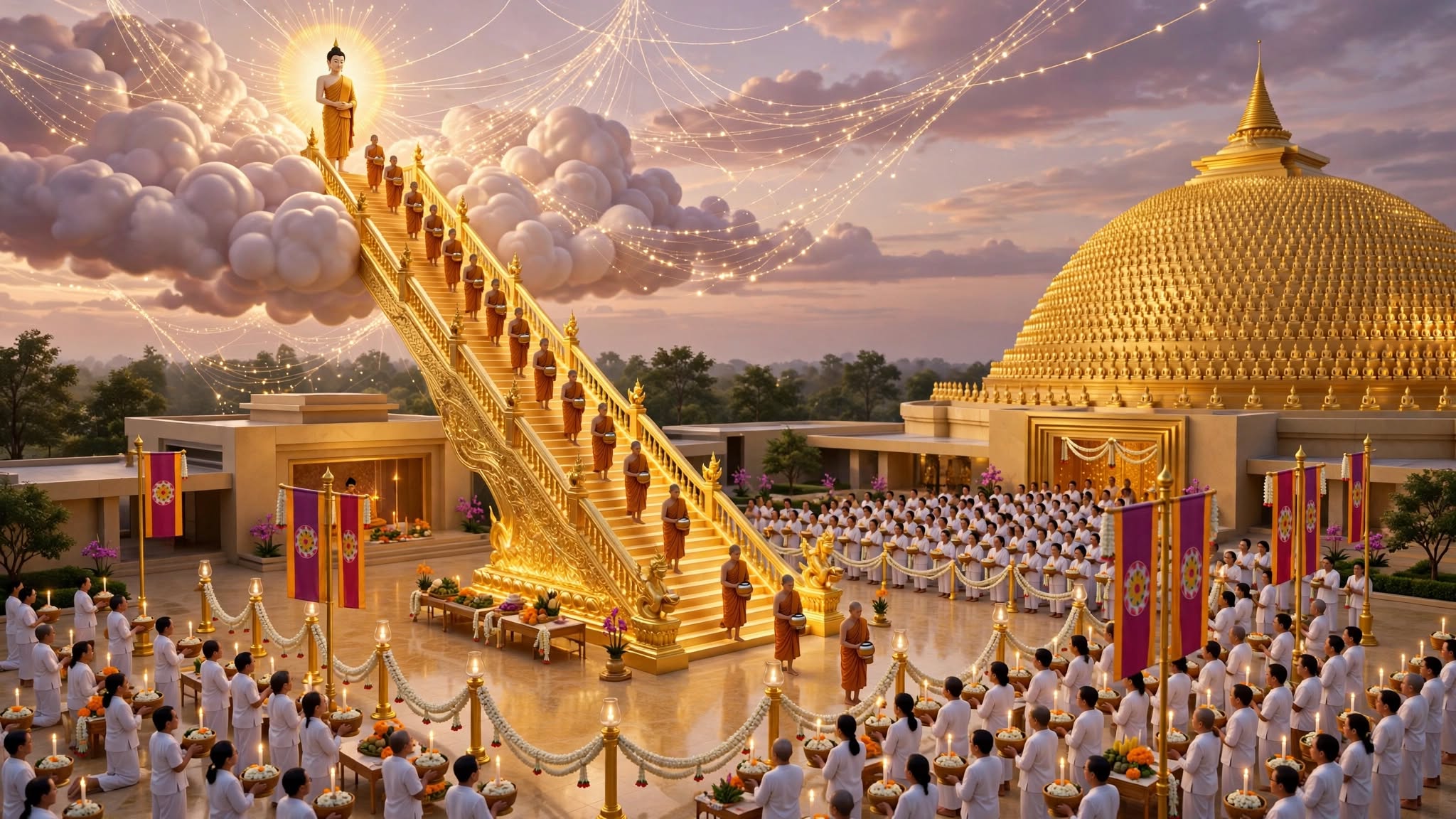
Wan Ok Phansa is the end of the Buddhist Lent, and at Wat Phra Dhammakaya it is followed the next day by Devorohana Day, also known as Tak Bat Thewo. Together the two days close the rains retreat and commemorate the Buddha’s descent from Tavatimsa Heaven.
When is Wan Ok Phansa?
Wan Ok Phansa falls on the full moon of the 11th lunar month, which falls in October on the Gregorian calendar. As with all Thai lunar observances, the exact date shifts slightly from year to year, so the day is best described as “around October”.
Tak Bat Thewo is observed on the following day, so the two celebrations form a single weekend of activity at the temple.
The Pavarana ceremony
Wan Ok Phansa is the day of the Pavarana, the closing of the rains retreat. Monks who remained in one place through the three months of Khao Phansa formally declare the retreat complete, and the assembly recites the Pavarana verses before the end of the day is announced.
In practice, the ceremony is a moment of release. The restraint of the rains ends, monks are free to travel again, and the community that supported them through the season formally closes the period together.
Why the Buddha is said to have descended
Tak Bat Thewo, or Devorohana, commemorates the account in which the Buddha is described as descending from Tavatimsa Heaven with his disciples. The story marks both the close of the three-month rains and the return of the teaching to the human world.
Devorohana also coincides with the end of Phansa Puja, and the temple observes it with alms-giving, Dhamma talks, and an evening candlelight ceremony around the Cetiya.
Key activities
- Pavarana ceremony marking the close of the rains retreat.
- Morning alms-giving to the monks.
- Dhamma talks on the end of Lent and the Buddha’s descent.
- Evening candlelight around the Maha Dhammakaya Cetiya.
How to join — on site
Wat Phra Dhammakaya is at Khlong Sam, Khlong Luang, Pathum Thani 12120. Both days are open to visitors, and the Pavarana is a good occasion to observe if you have not seen a formal closing of the rains before. Dress modestly with shoulders and knees covered, and remove your shoes before entering the ordination hall and the Cetiya.
Arrive early if you intend to take part in the morning alms, as the hall fills quickly once the programme begins.
How to join online
Live coverage is shared through the temple’s Line OA “@dhammakaya” account and the official Facebook page, and is also broadcast by the DMC channel. Online participants commonly join in the alms intention, follow the Dhamma talks, and light a candle at home for the close of the Lent.
Preparing for the day
Because the two observances fall on consecutive days, many visitors treat the pair as a single visit and stay overnight near the temple. Those who do so often describe the sequence as the natural close of the Buddhist year: the retreat formally ends, the community acknowledges what was sustained through it, and the new season begins the following morning.
- Plan for two days, since Wan Ok Phansa and Tak Bat Thewo fall on consecutive days.
- Arrive early if you want to join the morning alms.
- Dress modestly with shoulders and knees covered.
- Bring water and a small cloth, and be ready to remove your shoes.
Plan your merit-making all year
Wan Ok Phansa and Tak Bat Thewo are two of many merit-making events at the temple. See the Dhammakaya Merit Calendar to plan your year of dana, sila, and bhavana.
References
พักใจเติมพลังบุญ 5 นาที ณ ศูนย์กลางกายฐานที่ 7
หลังอ่านบทความนี้ ลองหลับตาเบาๆ ผ่อนคลายร่างกายและจิตใจ ร่วมบันทึกสถิติสมาธิของคุณในระบบเพื่อสะสมพลังบารมีในทุกๆ วัน
🧘♂️ เริ่มต้นบันทึกสมาธิวันนี้ (ฟรี)ติดตามทาง LINE Official
รับข้อคิดธรรมะสั้น 2 นาที & เตือนวันพระ สะดวกบนมือถือ