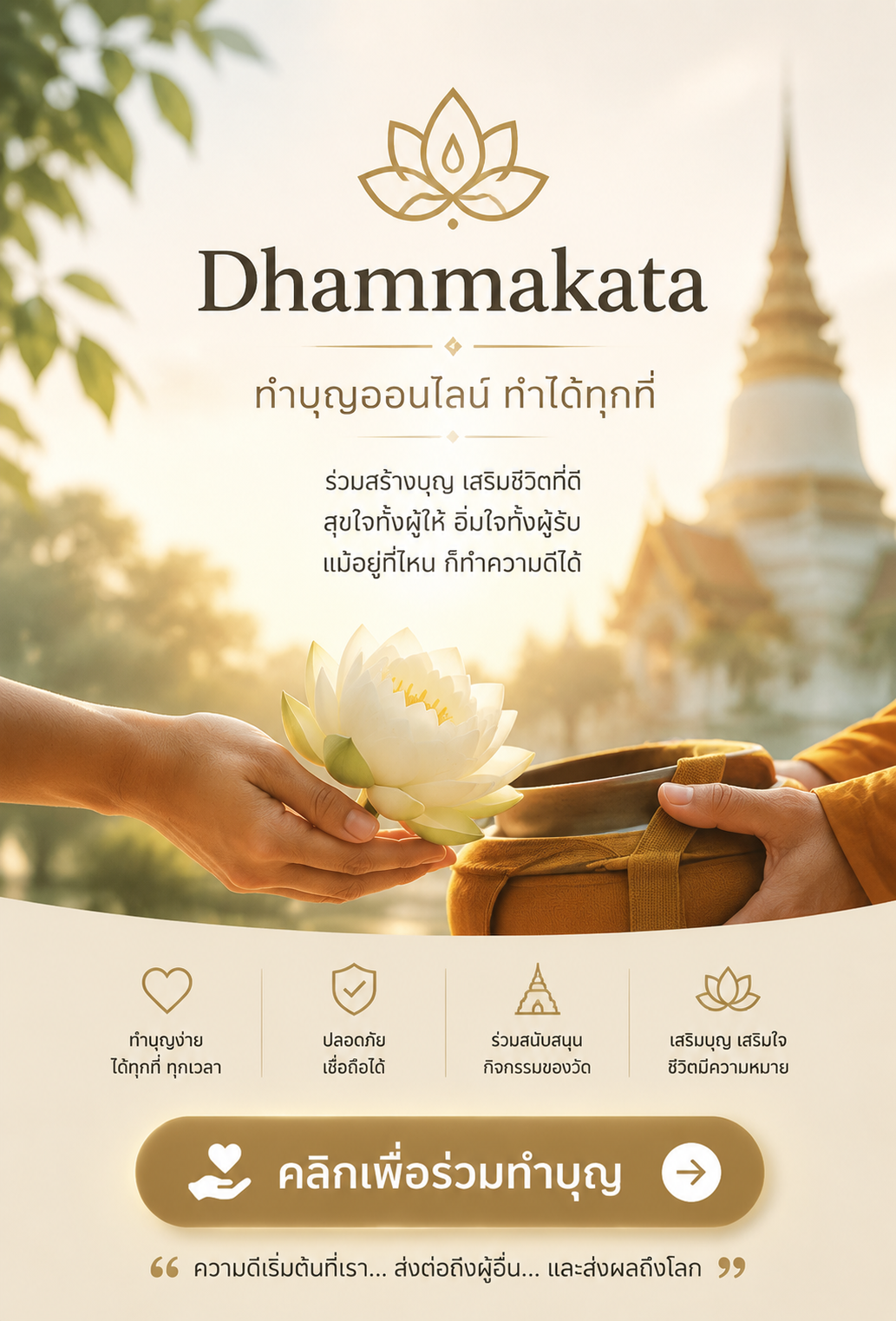
Executive Summary: Food Offering Merit
An uplifting karmic case study from the Dream in Dream Kindergarten Wisdom School, taught by Ven. Luang Por Dhammajayo. This case demonstrates the profound power of offering high-quality food to the monastic community. It explains how providing sustenance to monks translates directly into lifelong abundance on Earth and magnificent celestial wealth in heaven.
1. Food is Life: The Gift of Sustenance
Offering food (Bhojana Dana) to practicing Buddhist monks is considered an act of sustaining the Buddha’s teachings. Because monks rely entirely on alms to maintain their physical bodies for meditation and Dhamma study, providing them with food is functionally equivalent to offering them life, strength, beauty, and intelligence.
In this case study, the individual made it a lifelong habit to offer alms daily. They meticulously prepared exquisite, delicious, and hygienic food for the Sangha. Crucially, this was done with overflowing joy and a mind entirely free from stinginess or regret.
2. The Fruits of Abundance: Present and Future
The merit generated by consistently offering fine food yields comprehensive blessings:
- Worldly Prosperity: In their present life, their businesses thrived and wealth flowed effortlessly. They never experienced starvation or severe poverty. Even during economic crises, the merit attracted benefactors and unexpected opportunities, proving the karmic principle that “the more you give, the more you receive.”
- Vibrant Health: Because giving food is giving life and vitality, the karmic reflection is a long lifespan, robust physical health, a radiant complexion, and freedom from chronic diseases.
- Celestial Wealth (Dibbha Sampatti): Upon passing away, their bright astral body ascended to the Tavatimsa Heaven. There, they were greeted by a magnificent golden mansion and an endless supply of “Celestial Food.” In the heavenly realms, this merit allows devas to manifest whatever exquisite sustenance they desire simply by thinking of it, without any physical labor.
3. Theravada Canonical Tipitaka References
The Buddha frequently elaborated on the five specific blessings that return to a person who offers food:
Bhojana Sutta (Anguttara Nikaya 5.37)
“Monks, in giving a meal, a giver gives five things to the recipients. What five? They give long life, beauty, happiness, strength, and intelligence. Having given these five things, the giver will partake in long life, beauty, happiness, strength, and intelligence, whether in the human realm or the heavenly realm.”
4. Guidance for Maximizing the Merit of Food Offerings
Luang Por Dhammajayo offered practical tips to ensure that food offerings yield the maximum possible merit:
- Quality and Purity: The food must be prepared with care, clean, delicious, and purchased with money earned through honest means (Right Livelihood).
- The Three Phases of Joy: The mind must be radiant and joyful at three specific times: Before giving (while preparing), During giving (offering with respect), and After giving (rejoicing without a trace of regret).
- Offer as Sanghadana: Rather than offering food specifically to a favorite monk, one should offer it to the monastic community as a whole (Sanghadana). This removes personal attachment and demonstrates pure reverence for the Triple Gem, yielding significantly higher merit.